
GREEK WORLD · SELLER-REPORTED c. 400 BC
Greek Bronze Arrowheads I
TWO BRONZE ARROWHEADS · 8-INCH DISPLAY
£84.95
In the age of Greek city-states, mariners crossed the Ionian Sea to new harbours, neighbouring kingdoms and communities along the Adriatic. Explore the classical world around 400 BC before discovering four paired bronze-arrowhead displays.
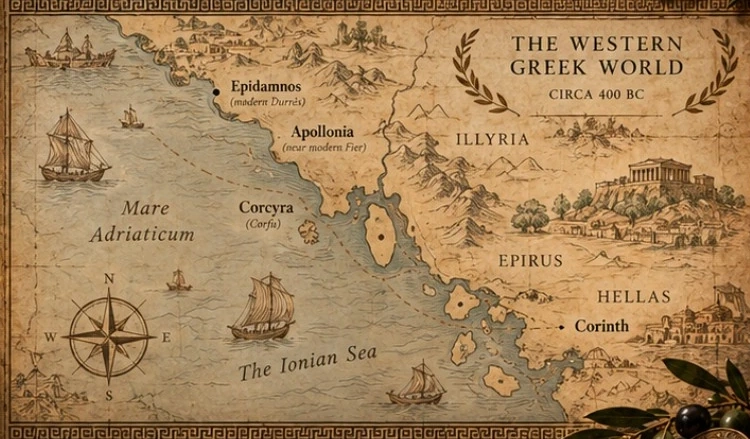 CORINTH · CORCYRA · THE ILLYRIAN COAST ENLARGE MAP ↗
Before the age of Alexander, Greek communities were connected by trade, rivalry and journeys across the sea.
READ THE STORY ↓Four pairs, each displayed upright in an 8-inch shadowbox — an antiquarian study of early bronze point forms.
04 PAIRED EXHIBITSTWO BRONZE ARROWHEADS · 8-INCH DISPLAY
TWO BRONZE ARROWHEADS · 8-INCH DISPLAY
TWO BRONZE ARROWHEADS · 8-INCH DISPLAY
TWO BRONZE ARROWHEADS · 8-INCH DISPLAY
Around 400 BC there was no unified Greek empire. Independent poleis maintained trading, religious and political connections around the Mediterranean. Corinth and Corcyra were closely linked to shipping routes across the Ionian Sea, while the Greek-associated settlements of Apollonia and Epidamnos lay along the eastern Adriatic coast.
These ports bordered communities often described collectively as Illyrian, whose cultures and political organisation were distinct from those of the Greek city-states. Our historical map sets the wider regional scene, rather than confirming the findspot of any arrowhead.
The eight bronze arrowheads were sold as Classical Greek examples dated around 400 BC. The seller reported acquisition from an Eastern European collection, said to originate in former Yugoslavia. This account has not been independently substantiated; the precise cultural attribution, age and findspots remain uncertain.
Preview only. Checkout remains disabled while artefact descriptions, final photography and payment acceptance are being prepared.