
GREEK WORLD · CLASSICAL PERIOD
Greek Bronze Arrowheads I
TWO BRONZE ARROWHEADS · 8-INCH DISPLAY
£84.95
In the age of Greek city-states, mariners crossed the Ionian Sea to new harbours, neighbouring kingdoms and communities along the Adriatic. Explore the classical world around 400 BC before discovering four paired bronze-arrowhead displays.
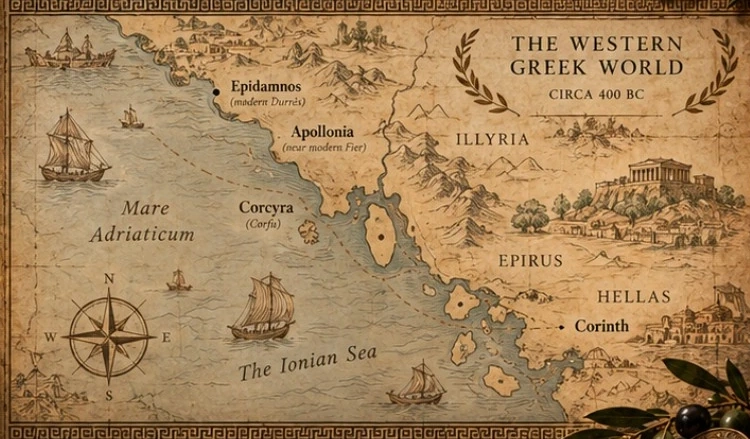 CORINTH · CORCYRA · THE ILLYRIAN COAST ENLARGE MAP ↗
Before the age of Alexander, Greek communities were connected by trade, rivalry and journeys across the sea.
READ THE STORY ↓Four pairs, each displayed upright in an 8-inch shadowbox — an antiquarian study of early bronze point forms.
04 PAIRED EXHIBITSTWO BRONZE ARROWHEADS · 8-INCH DISPLAY
TWO BRONZE ARROWHEADS · 8-INCH DISPLAY
TWO BRONZE ARROWHEADS · 8-INCH DISPLAY
TWO BRONZE ARROWHEADS · 8-INCH DISPLAY
Around 400 BC there was no unified Greek empire. Independent poleis maintained trading, religious and political connections around the Mediterranean. Corinth and Corcyra were closely linked to shipping routes across the Ionian Sea, while the Greek-associated settlements of Apollonia and Epidamnos lay along the eastern Adriatic coast.
These ports bordered Illyrian communities with their own rich traditions, connecting the Greek seaways with the western Balkans. The map evokes the cities, coastlines and trading passages that shaped this remarkable meeting place of cultures.
Four thoughtfully balanced pairs of bronze points will be displayed upright, their sculptural three-sided forms and aged patinas showcased against white recessed mounts. Each finished frame is conceived as a small antiquarian exhibit in its own right.
The seller attributed these bronze points to Classical Greece, c. 400 BC, and reported their acquisition from an Eastern European collection said to have originated in the former Yugoslavia. That account is not documented independently, and individual findspots are unknown.
The collection is being prepared for release. Final exhibit photographs will accompany each listing.